FF1 Part 2 - Parts Build
Previously: Part 1 - Design
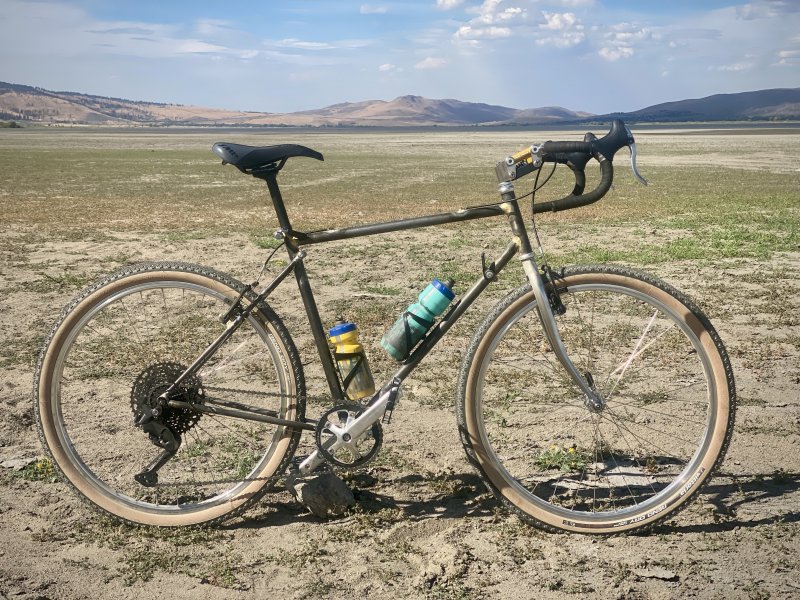
This is part 2 about FF1, covering the build. Some of the choices were made before the frame was started, others were made "in situ". Here's how it looked on its first real ride:
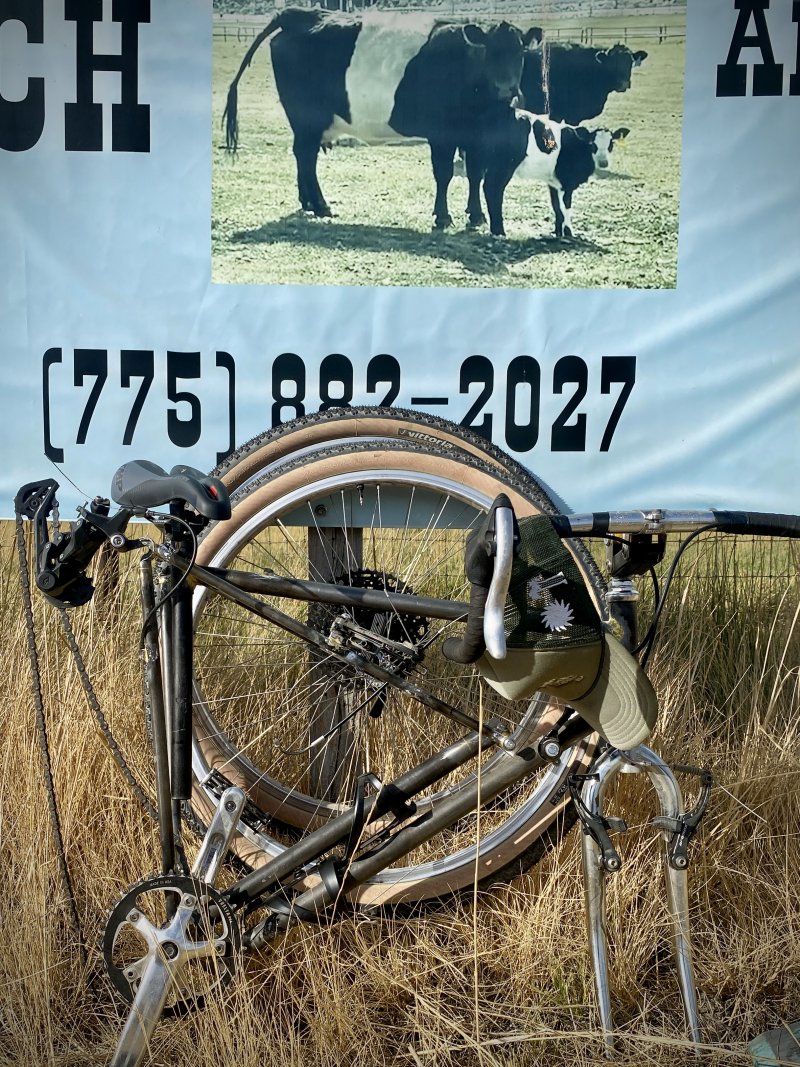
And folded on the side of the road:
Wheels and tires
I already had 650b Velo Orange rims from some kind of retro rando/camping bike concept I was thinking about. Ironically, this bike didn't want to be all that retro. I had these rims on my tandem and they're tough and dependable and should make it through TSA without bending.
I found a good closeout deal on Vittoria Terreno Drys and I like the skinwall look. They also could be edited to say "RENO DRY" which was apt since I live close to the "biggest little city".
For the front hub I had a NOS Shimano XT M730, made from 1987 to 1993. They have grease ports on the seals which is neat.
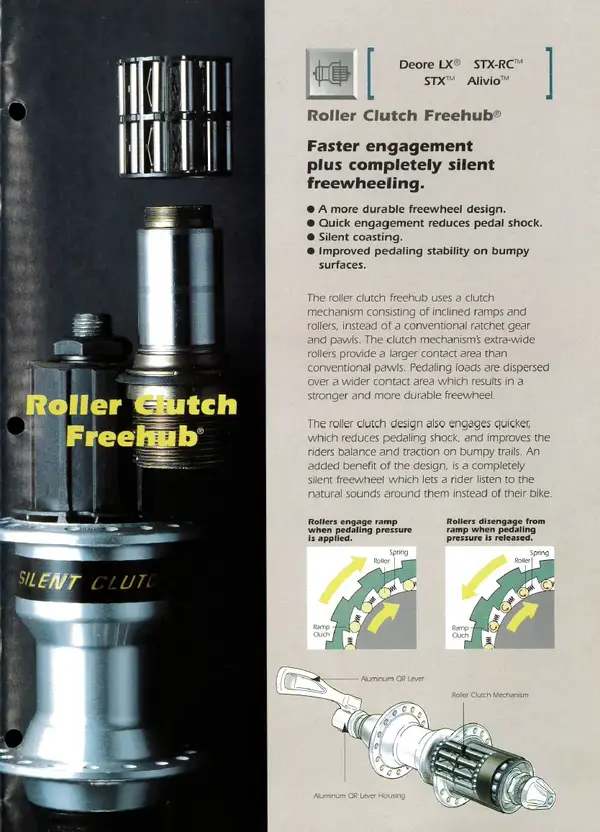
For the rear hub I had two 135mm choices I've been wanting to use. One was an old DT Hugi Compact which would be a great choice for touring and travel given the reliability of the star ratchet system. But there was another weird option: a Shimano FH-R080 "Silent Clutch" hub they made starting in 1997 that used a roller clutch (similar to what is used by Onyx today). To keep the clutch from exploding itself these are much heavier than the standard Shimano options so they didn't last long in the market. Supposedly bike cops liked them so they could quietly sneak up on (fill in the blank), but maybe that's just bike lore. Since this bike might be used for sneaking up on birds to add to the birding list or otherwise enjoying the quiet and solitude of the outdoors, I decided to go with the Shimano.
I set them up tubeless for now since we have goatheads. Maybe for travel I'll run tubes with sealant to make things cleaner to work on, but I'm not really sure. At first they refused to stay inflated, but it turned out the DT valve stems I grabbed didn't cooperate with the profile of the rim and switching to some with a more conical rubber seat fixed it right away.
Cockpit
For the seatpost I had a Cannondale alloy post in 25.4 with a nicer two-bolt, set-back clamp than your average Kalloy. For the seat I wanted to run an SMP but the only narrow available one I had loose was an Extra. Good enough.
I had a bunch of swept-back bars in 31.8, include a Velo Orange Granola and a Soma Port Mann. But when I went digging for my quill stem adapter it was nowhere to be found. Then I remembered it ended up on a friend's road bike with a tall stem and I hadn't replaced it. I did have a set of steel North Road bars that were all backsweep and a long MTB quill stem to mount them and they felt OK riding around. The long stem looked a little goofy though so I'd have to wait for something that swept forward more.
Next to try out drop bars.
Enter Flexstem
A year or two ago I found an old 120mm Softride suspension stem at the co-op and had to buy it, now that flexstems are cool again on gravel bikes. Back in the 90s when I worked in bike shops I had a customer who swore by it for MTB but when "tested" behind the shop, bunnyhopping curbs and landscaping, we mechanics all agreed it was terrible. But for a touring-esque bike that sometimes sees some rough roads maybe I could fit it into some project?
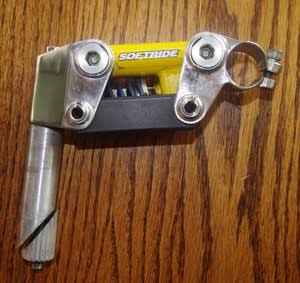
There is a catch, of course. Not only is it a quill stem for 1" steerers, it's 25.4 mm for mountain bike bars. But I owned some Nitto 25.4 drop bar options - a 115 and some Noodles. Then I found some Fairweather 174s, and some Randonneurs.
And here I was, with a touring bike project that needed a quill stem. A quill stem with positive rise. Maybe it made sense here? Especially since I was using a smaller wheel that wouldn't be quite as smooth. Without a quill adapter I discovered it was one of my only choices with what I had. All my other quill stems were too long, or negative rise which didn't look right.
So I put it on and it looked.. kinda good. I tried it with the Fairweathers first and they felt cramped. I considered the Randonneurs but they were narrower at the hoods. Between the 115 and the Noodle I prefer Noodles. They turned out the be the orignal 26.0 Noodles but they fit in the stem (see Part 3 though!)
At first the stem didn't do much at first but it needed some lubrication. Once lubricated it almost did too much, and I could bottom it out if I was standing over the bars. But when riding you can't put that much weight on it unless your really slam into something hard. It otherwise does an great job smoothing out the ride, so well that I'm thinking I might have to collect some more.
And I know I said I was done with drop bars but maybe this is the exception.
Before you get excited and try to grab some for your gravel bike - remember even though you can get them in 1 1/8 threadless version, they're all for 25.4 bars. And the real deal killer is that the shortest one is 120mm, so unless you have ape arms like me it probably won't work.
If I really get excited about them I might consider making 31.8 face plates to let you run them with newer handlebars, but I need to ride them more to see if the excitement wears off.
Brakes
For the V-brakes I first considered the LitePro models but held off buying them. Pauls Motolites were too precious. Then I found the Promax P1s. They look very normal and are cheap, not just in price but in construction. They work enough. The spring adjustment is fickle, and the pads are very average.
For levers I had some oddball V-brake drop bars levers labeled "Power" that appear to be Tektro clones. I'm surprised there was a big enough market for this style of lever to justify knocking off a Tektro, but they work and are a nice shape and the Tektros are gone anyway.
Dia Compe made a new, more modern replacement of the 287V, and they just recently got US distribution through Rivendell. But though pretty looking, they use the skinny outdated body and hoods from the 287V.
I recently discovered a stash of what look like Tektro V brake levers on eBay for all of $13 so I would have had a modern hood option.
The leverage ratio with the brake pads higher seems about right in terms of power and pad clearance. I would not be shocked that V-brake drop bar levers actually have a little more leverage than they should and detuning the ratio on the brake end gets the leverage closer to what was originally intended.
Drivetrain
I had all sorts of shifter options for flat and drop bars, but it would mean more cable to fight when packing the bike. Down tube shifters would be cleaner and I had clamp-on shifter bosses and cable stops to experiment with. I decided to start with the shifters there to test them and maybe rule them out. I actually like them as long as they're indexed (and that goes for any location).
In some of the early mockup builds I thought about running a front derailleur and going more retro, but these days I feel like if you're going to go retro you have to go all-in, and this bike wasn't quite the right platform. And I have worked on enough front derailleurs in my life that I'm happier avoiding them.
So that left us with... down tube shifters and 1x? I had some 8 speed shifters and a Sunrace MX900 rear derailleur that's a 1X design and uses the old Shimano pull ratio. And now you can buy wide-range 8 speed cassettes. I'd have to wait for that cassette though. What else was in the parts bin?
I had some 9 speed Cues setups that Rivendell was blowing out, and I had a 9 speed Linkglide cassette on the bikepacker that I could steal, but no real good flat bar setup yet. Drop bars would require buying Cues U3030 levers, the right alone being almost $200. No indexed down tube shifters exist for Linkglide.
Then buried all my pedals I found an extra 11-48 Advent X 10 speed cassette. I had some drop bar options to shift it - matching 11 speed (same spacing) Microshift SB-m110 (Advent but not 10 speed) shifters and a pair of Gevenalles with the Microshift thumb shifter. Microshift sells that thumb shifter as a down tube shifter, but in pictures it looks a little clunky. But heck, I had the clamp on mount and the shifter so I mounted it to the down tube. First thing that I discovered is that the 11 speed shifters are clocked so that the highest gear position is angled below the axis of the down tube, so it worked out aesthetically that I was running it with a 10 speed cassette and could skip the first click. I paired it with the plastic fantastic Cues rear derailleur since it had a cable adjuster. It needed a bunch of b-screw to clear the 48 but it shifted fine despite being mostly plastic. For the chain, I had an LG500.
For cranks I had several options, with the decision coming down to chainring choice. Some were 110 BCD, others 104, and one was SRAM 3-bolt direct mount. I had the most chainring selection in 110, so I ended up with some old Soma cranks in 155. My last gravel bike had 38 x 11-42 on 29s, so with the 48 in the back and the smaller wheel a 42 ring went on the front. For setting the bike on the ground I'd like to add a chain guard in the future, once I finalize the chain ring size. For pedals I'm using some generic flat things label Mzyrh, and they're fine. Once I get to travel with it I'll splurge on some MKZ EZY pedals that have quick releases.
Bags
Next to figure out is bags for touring. I have some Clickfix handlebar bags that will probably go in the front. They keep the tops of the bar free. But maybe something that doubles as a hip pack is good idea.
In the back I could use one of my bikepacking "buttrockets". I also have an old Carradice Nelson Camper Longflap that probably holds more, I just have to figure out how to mount it to whatever saddle I end up on. I do have an old clamp-on rail adapter that might work.
There's some potential in making a mini support rack for the Carradice that mounts to the top seatpost clamp boss and can also fold up for transport.
Finally - the bag for the bike. I can sew so I'll probably make something out of Cordura based on the various more rinko-level bags out there. In the mean time, I need to ride the bike more, which brings us to Part 3 - ride feedback and parts changelog.