Quiver Killers or Killer Quiver
Not-so-fat Bike
Winter was a total bust. We barely had any snow down in town. So little that I questioned whether I should bother with a fat bike any more, if winters were going to be like this.
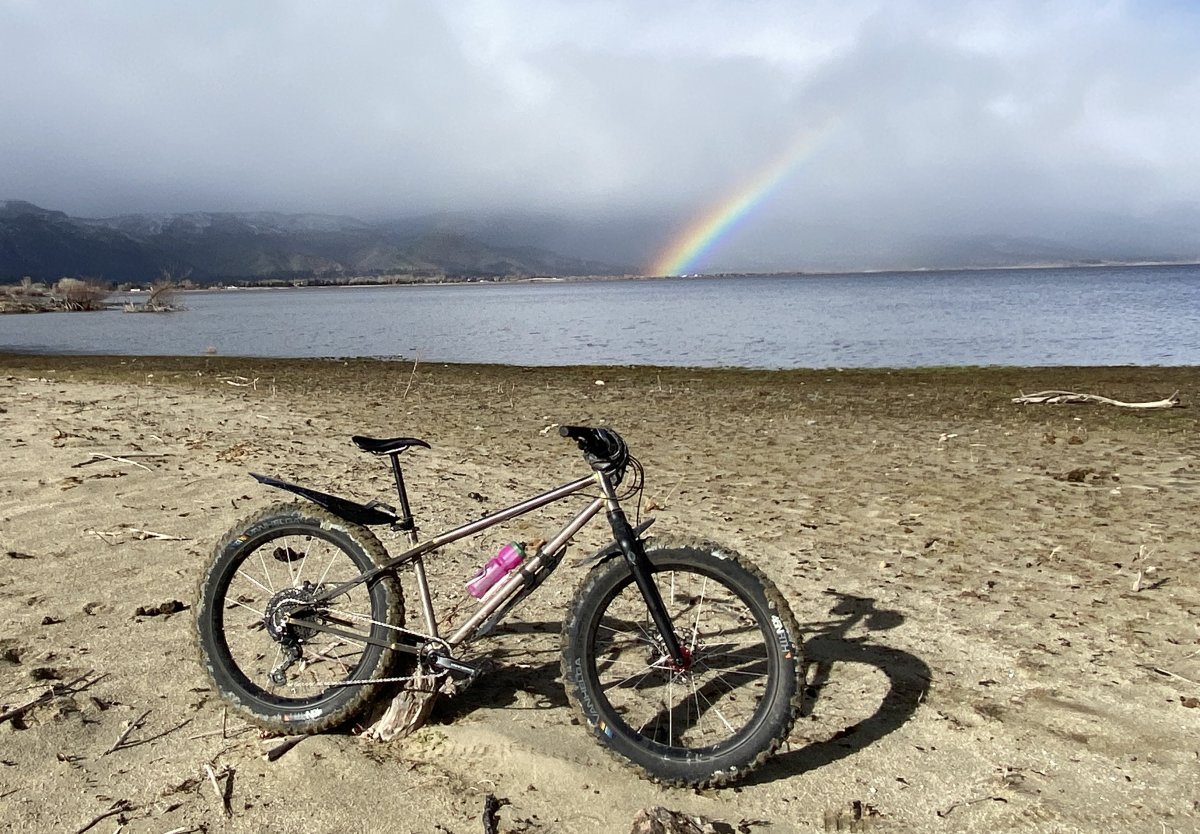
But we also have plenty of sand here. I love riding the shoreline of Washoe Lake in the winter so a bike that can traverse sand does have some value. There are some large sandy areas nearby that I've barely explored and a good sand bike could open up new riding options. Since most of my bikepacking is in the desert fatter tires do make some routes less of a slog.
Then late last fall I got a Duro Crux. I first tried it on the front of the single speed and loved it as a trail tire. Since my single speed runs a 150mm fat bike fork, I also tried the wheel on the fat bike, and installed a second Crux onto the fat bike's summer 29+ rear wheel.
These tires are mind blowing. They roll quiet and fast in an impossible way. They almost have too much traction on dirt, at least in the back. If you believe The Tractor Paper, the increase in radius should make them work as good as if not better than say a 27.5 by 4". In fact, measuring just bead-to-bead the Crux measures 200mm with a tread width of 100mm while a Vee Snowball 4" tire is 215mm and 110mm respectively. The final difference in width comes from just the rim. So if this tire is nearly a fat tire, could this tire be decent on snow?
Pal Pete up in Detroit reported some of his Michigan buds were doing their fatbiking on Cruxes too. This data point got me even more curious.
Once some semblance of winter finally arrived I got to try the Cruxes on snow. Unfortunately I only got two opportunities. The first was some soft fresh snow in town, and they seemed about as good as anything else in powder that's too soft to float. The second ride was on firm groomed ski trail, and I can't see needing anything more than the Crux.
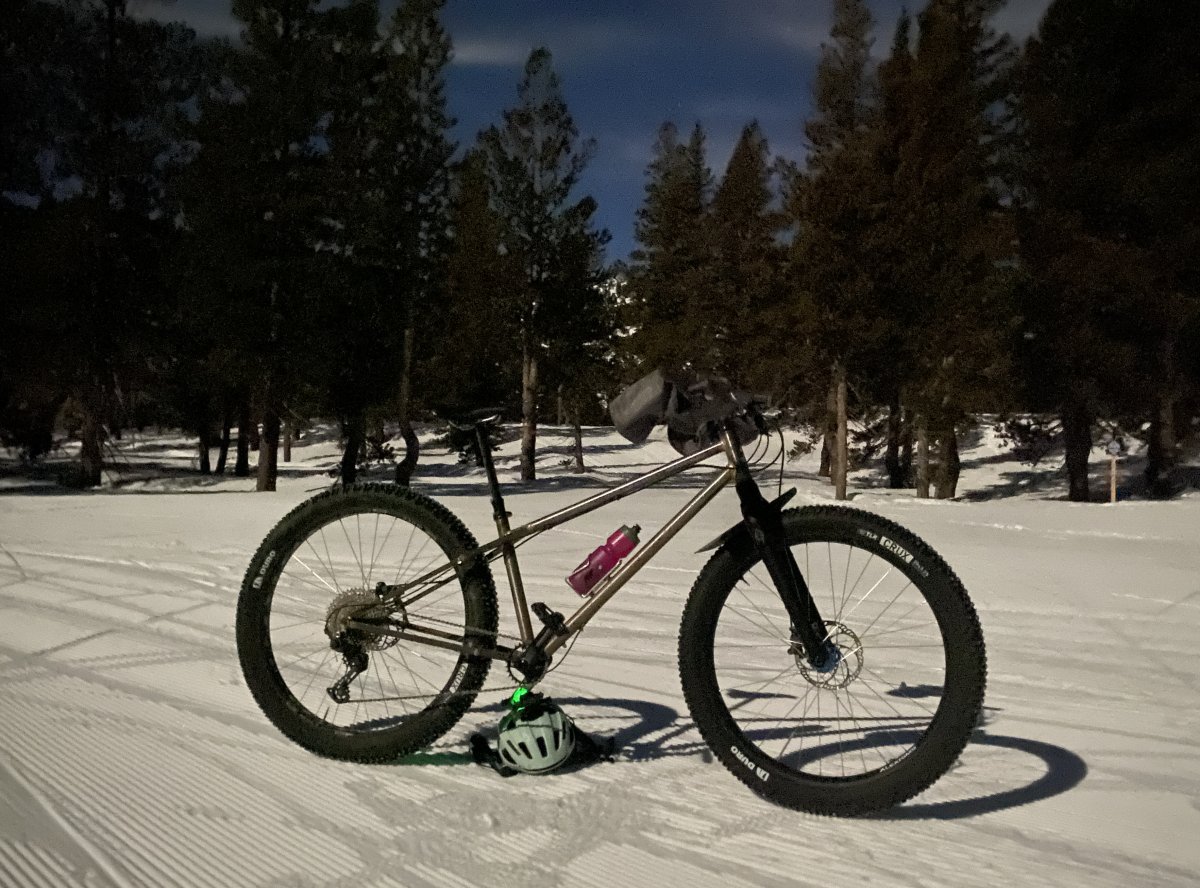
So now I'm seriously considering something that can fit Cruxes that will be a "good enough" fat bike, but can run on SuperBoost in the back. Then I can clear out my extra fat bike wheels with 197 rear hubs and fat bike cranks. I guess I'll keep the 150 hub in the front. Could this be one bike that "does it all"?
Rule of Three
The classic bike joke is the the perfect number of bikes is N+1 where N is the number of bikes you own right now. But if you're over Gear Acquisition Syndrome, I think there's a better rule. The perfect number is three: two bikes that are opposites on some metric, and a third that covers something completely orthogonal to the first two.
But then there's the mythical Quiver Killer, the one bike to do it all. Usually this is really one frame and multiple wheels. But try to spread the responsibilities too far and you get a Homercar that does nothing well. There's a point where having a killer quiver is more fun.
With three sets of wheels my fat bike can sort of do it all, but the geometry was designed almost totally for snow performance. The previous fat bike had very progressive trail geometry which was more fun on trails but didn't work great on snow so it sort of defeated the point of a fat bike. I like to design around the 80% use case, which fat biking isn't. If I add in bikepacking to snow/sand riding I get a better percentage and the bike justifies itself better.
I've had no problems touring on fat bikes, but one thing I notice riding trails is that the wider cranks are easier to hit on the sides of a cupped trail. They sweep a wider envelope in general and the pedal strikes can be annoying at least and maybe a bit dangerous at most. Wide cranks don't bother my knees or hips, but for more general use I'd like to go narrower. Many modern cranks now run 55mm chain line which is around where the 150 and 157 rear hub standards were aiming for, so there are now more options for stock cranks. I do have some 83mm shell Race Face cranks I could use too, and the wider shell might simplify the chainstay design.
The design challenge presented is more about tire clearance to the chain. Some fat bikes have gotten narrower cranks by using a narrower standard with the chainring flipped or offset more, but they stick to fat bike rear hubs. My goal here is the opposite, to see what I can get away with using a 157 rear hub. With a 55mm chain line I could potentially clear up to a 100mm tire, like the Tumbleweed Prospector can do with a Rohloff.
As the chain moves inwards shifting to lower gears on a cassette, the clearance goes down. This could be mitigated somewhat by running a shorter cassette spaced out. This could be the CUES 9 speed that is spaced out one cog's worth, or I could take something like a 10 speed 11-48 cassette, take off the 11, 13, and maybe 15 tooth cogs, make up the thickness with spacers behind the cassette, and have a good setup for softer surfaces.
I could also eke out a little more tire by running a 27.5 x 4 tire on a 50mm rim, which would put it around 3.75" wide.I don't have one set up on a fat bike hub to test on the fat bike, just a Super Boost hub, but I don't think it will fit any other of my frames.
Master of Some
Could I make this a trail bike too and give up the singlespeed? I'm not sure I want a Killer of Quivers that's also a master of none, so maybe this thing runs Race Kings as an All Gravel Bike in the summer and Cruxes in the winter. Or maybe I just don't bother with tire swapping either? I do ride trails quite aggressively so I think that justifies a dedicated bike. And somehow full rigid with gears sort of feels like fence-sitting.
One idea that could work well is to have an adjustable rear end. With the dropouts further back you get more clearance for a fat tire, smoother touring, and more weight on the front tire in soft conditions. Pushing the wheel forwards gives the front end more "pop" for trail riding, and I don't need as much rear traction or float for trail riding. The shorter position could be designed around a mullet setup. The adjustment range could also have some vertical movement to it to further adjust the geometry. With a mullet setup this could even be two different dropout locations and maybe you can line things up so they use different rotor sizes with the same caliper location?
Ideally this setup would have two rear wheels - the 29 Crux with gears, a matching chain with a quicklink, and the rear derailleur, cable, and shifter (with a split clamp) ready to install and zip tie as needed. Then the trail setup is a 27.5 (to make it interesting) with a single speed cog and its own shorter chain. Ideally the brakes don't need any adjustment. Sliders or rocker dropouts would work there, though maybe the dropouts stay on the wheel and you swap the whole assembly.
Thinking it Through
An option to simplify things would be to bikepack on the single speed. I'm not too excited about this since we have a lot of steep backroads, but I've also pushed my geared bike up plenty of them so maybe it's not so big a deal. I can think of some routes that really call for low low gears, but at that point pushing is the same speed anyway. I guess I should give it a try.
We could stretch the definition of singlespeed to include dinglespeeds (double-geared singlespeeds). For bikepacking I could run a "reciprocal dinglespeed" with matching cogs and chainrings. For example, I could run 24-36 cranks and get a 36/24 regular gear and a 24/36 climbing gear. The question then is whether there's really any value to stopping and switching gears to be able to pedal at walking speed, versus just accepting your fate and walking the steep stuff anyway.
One way this could go wrong is if it gets too annoying making the swap. But realistically I'll only bikepack on it twice a year, and then keep it in fatbike mode once the trails get snowed in. However, the wildcard is the sand riding and whether I want to ride that stuff often enough to swap back and forth or if I should still dedicate a bike to it. Sand biking definitely calls for low gears.
Frame #27 now in construction will have gears and 650x47 tires so it could take of those rides where more distance needs to be covered and soft surfaces aren't expected. It wasn't intended to be a primary bike and is more of a design exercise, but maybe it will end up taking some pressure off of some of my quiver's responsibilities.
In my current setup, the fatbike and the singlespeed are the opposites in the rule of 3 (going slow on dirt, going fast on dirt), and #27 would be orthogonal (not dirt). The challenge in simplifying the two dirt bikes would be to keep the breadth in both directions as wide as possible. But since the singlespeed needs a refresh more desperately than the fatbike, I should probably bias it still towards the trail end of things.
Overthinking it
Back in the day, Keith Bontrager made superlight mountain bike rims by taking 40 hole road rims, cutting out a section of four spokes, and rerolling the rim to a 26" circle. In theory, you can do the opposite. Take a pair of 32 hole 27.5 fat rims, cut them into two 18 hole sections, open up the radius, and pin them together into a single rim. You now have a 29" fat rim.
I've also seen people take single-wall rims like a Mulefüt and add a new center section to make them wider but that's a lot of area to connect.
This would result in a single-purpose rim so that is marginally better and probably isn't worth complicating the project. But I like considering some extremes to help define the edges of the project.
Someone on MTBR posted their 29" fat tires that were made by taking a fat tire, stretching it out bigger, then making a new 29" tubeless bead with aramid thread but tire manufacturing is a learning curve steeper than what I want to take on.
Enough dithering
The Crux seemed like it was good enough last winter. But before I embark on this project I'd like to have a better sense of whether the Tractor Paper's conclusions are applicable if even correct.
Instead of waiting for winter (if any), I'm going to take my fat bike out to the sand instead, with all three wheels sizes I own: 26 x 5 J5s, 27.5 x 4 Van Helgas, and 29 x 3.25 Cruxes. Then I can decide, head-to-head on the same terrain, whether the fat volume really justifies things for me.
Once I know that I can start designing the frame around the rear wheel.